


 HOME
HOMEHow Long Should Hydrostatic Pressure Be Held
18 August 2026
Written by: Marley Machinery Engineering Team
Hydrostatic pressure should be held for the minimum time specified by the applicable testing standard, product specification, or customer requirement. There is no single holding time that applies to every pipe or pressure-containing component. For steel pipe, the required hold period commonly ranges from several seconds to several minutes, depending on the applicable standard, pipe size, wall thickness, test pressure, product type, and inspection procedure. During the hold period, the pressure must remain within the specified tolerance while the pipe is checked for leakage, visible deformation, or other indications of pressure failure.
What Determines Hydrostatic Pressure Holding Time?
Holding time is not simply a matter of keeping the pipe under pressure as long as possible. The purpose is to provide sufficient time to confirm pressure stability and identify leakage or unacceptable pressure loss.
For steel pipe production, the required duration is normally established by the governing product standard. Common requirements may be specified by standards such as API 5L, API 5CT, ASTM A53, ASTM A106, ISO 3183, or by a customer's technical specification.
The actual time can vary considerably between products. A high-volume pipe mill may use a relatively short, controlled holding period for automated production testing, while pressure vessels or special components may require substantially longer testing.
|
Factor |
Effect on Holding Time |
|
Applicable standard |
Defines minimum test requirements |
|
Pipe diameter |
Larger internal volume may require additional stabilization |
|
Wall thickness |
Can affect pressure response and test behavior |
|
Test pressure |
Higher pressure requires controlled stabilization |
|
Product specification |
May impose specific minimum holding periods |
|
Leakage criteria |
Longer observation may be required for certain applications |
|
Production method |
Automated lines may use optimized, repeatable cycles |
Why Is the Holding Period Important?
The pressure-holding stage is used to determine whether the pipe can maintain the specified test pressure under controlled conditions.
A pressure drop does not automatically mean that the pipe has a structural defect. Pressure readings can also be affected by water temperature, trapped air, pipe expansion, pump response, sensor accuracy, or changes in the testing system.
For this reason, experienced engineers do not judge a test solely by whether the pressure remains perfectly constant. They evaluate the pressure behavior together with the applicable acceptance criteria.
A properly configured hydrostatic testing machine should therefore control not only the target pressure but also the holding time and pressure-recording process.
Practical Application in Steel Pipe Testing
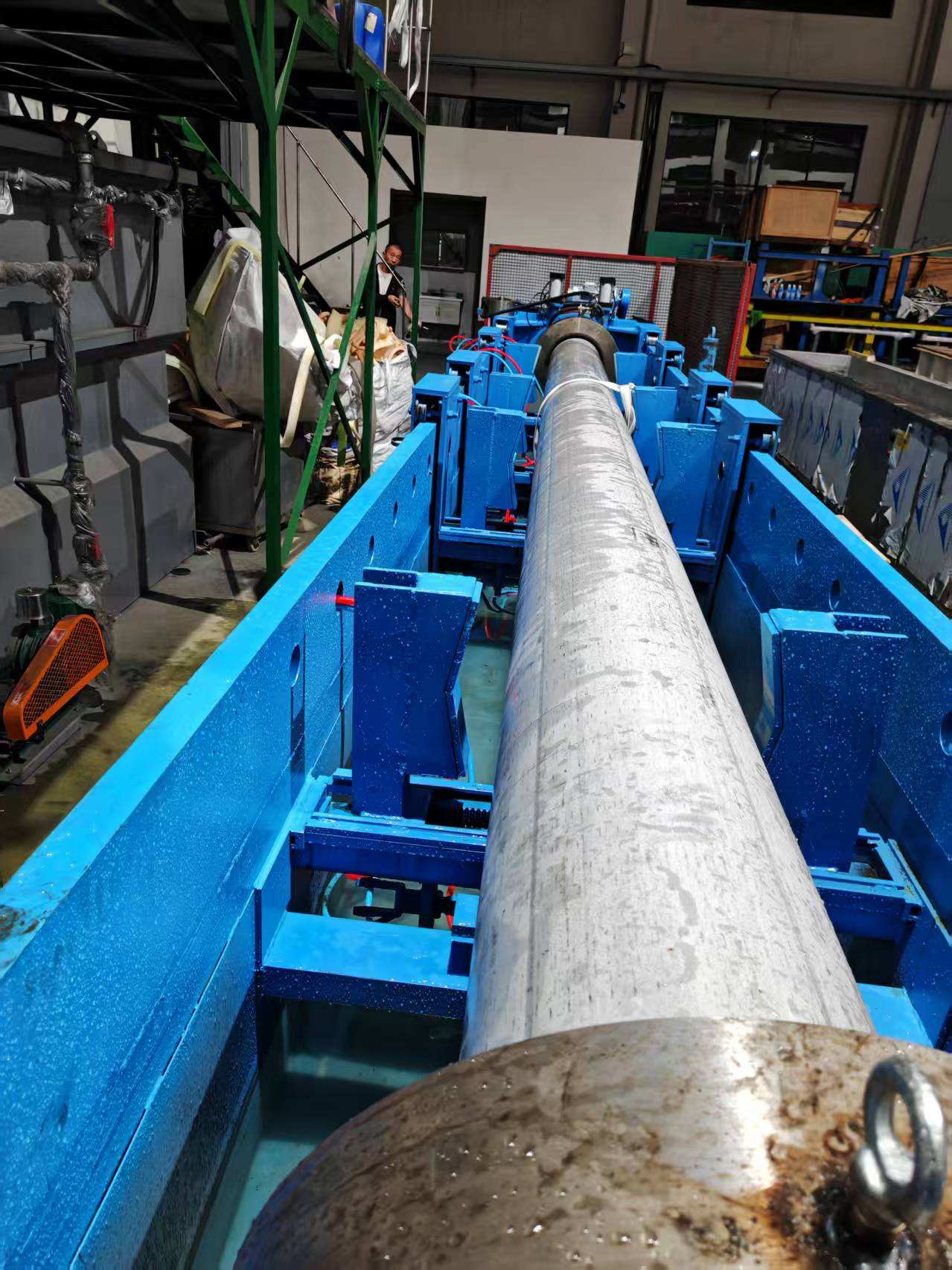
In an automated Pipe Pressure Testing Machine, the typical sequence is:
- The pipe is positioned and sealed.
- The pipe is completely filled with water.
- Air is removed from the test volume.
- Pressure is increased to the specified test pressure.
- The system stabilizes at the target pressure.
- The specified holding period begins.
- Pressure and test conditions are monitored.
- The result is recorded before pressure is safely released.
The important point is that the holding period should begin only after the required test pressure has been reached and stabilized, unless the applicable standard specifies a different procedure.
For production equipment, PLC control allows the operator to set the required pressure and holding time automatically. This improves consistency between individual pipes and provides reliable test records for quality traceability.
Common Misconception
A longer pressure-holding time does not necessarily mean a better hydrostatic test.
Extending the test beyond the required period generally does not improve the ability to detect defects if the applicable acceptance criteria have already been satisfied. It can instead reduce production efficiency and increase unnecessary loading on pumps, seals, valves, and other components.
The correct approach is to follow the specified test procedure rather than choosing an arbitrary holding time.
Important Considerations
Before setting the holding time on a hydrostatic testing machine, engineers should verify:
- Applicable product and testing standard
- Required test pressure
- Minimum holding time
- Pressure tolerance
- Pipe dimensions and material grade
- Water temperature and test-medium condition
- Pressure sensor calibration
- Leakage acceptance criteria
For automated steel pipe hydrostatic testing, these parameters should be controlled consistently across the production line. Any change to the holding time should be based on the governing specification rather than production convenience.
Hydrostatic pressure should be held for the minimum duration required by the applicable standard or testing specification, rather than for one universal period. For steel pipe, the required holding time can range from seconds to minutes depending on the pipe, test pressure, standard, and acceptance criteria.
The most important requirement is not simply the length of the hold period, but maintaining the specified pressure under stable and controlled conditions while accurately recording the test result. A properly configured hydrostatic testing machine and pipe pressure testing machine can automate pressure control, holding time, monitoring, and data recording to achieve consistent hydrostatic testing results.


