


 HOME
HOMEPipe Hydrostatic Testing Machine for Efficient Steel Pipe Manufacturing
24 August 2026
This is why, when we design a pipe hydrostatic testing machine, we focus on the complete testing cycle rather than only the pressure rating. Our goal is to help steel pipe manufacturers maintain reliable pressure testing while keeping the testing section moving at a practical production rate.
Where Testing Efficiency Is Lost
From our experience with steel pipe testing equipment, unnecessary time is often lost before and after the actual pressure-holding stage.
A typical testing cycle includes:
Pipe Positioning → End Sealing → Water Filling → Pressure Build-Up → Pressure Holding → Pressure Release → Unloading
The pressure-holding time normally needs to follow the applicable testing requirements, so it cannot simply be reduced to increase output. In our view, the better approach is to reduce unnecessary time around the pressure test.
|
Operation |
Common Production Problem |
Our Approach |
|
Pipe positioning |
Manual alignment takes time |
Controlled pipe positioning |
|
End sealing |
Repeated manual adjustment |
Hydraulic or automatic sealing |
|
Water filling |
Inconsistent filling time |
Controlled filling system |
|
Pressure build-up |
Manual pressure adjustment |
Automatic pressure control |
|
Pressure holding |
Continuous operator monitoring |
Automatic timing and monitoring |
|
Pressure release |
Manual operation |
Controlled depressurization |
|
Unloading |
Additional handling time |
Automatic or integrated unloading |
Reducing Non-Testing Time
When we discuss testing efficiency with pipe manufacturers, we do not look only at how quickly a machine reaches the required pressure.
Consider a production line where the pressure-holding period is fixed. If operators spend additional time positioning the pipe, adjusting the seals, starting the filling process, or removing the tested pipe, those delays accumulate throughout the shift.
This is particularly noticeable with large-diameter and long steel pipes.
For this reason, we design the testing process so that repetitive operations can be controlled as part of the machine sequence. The operator can then focus on supervision and abnormal-condition handling instead of manually controlling every stage.
In practical production, reducing several small delays can be more valuable than simply increasing the hydraulic pressure capacity of the machine.
Maintaining Stable Pressure Testing
Higher production speed is useful only when testing quality remains consistent.
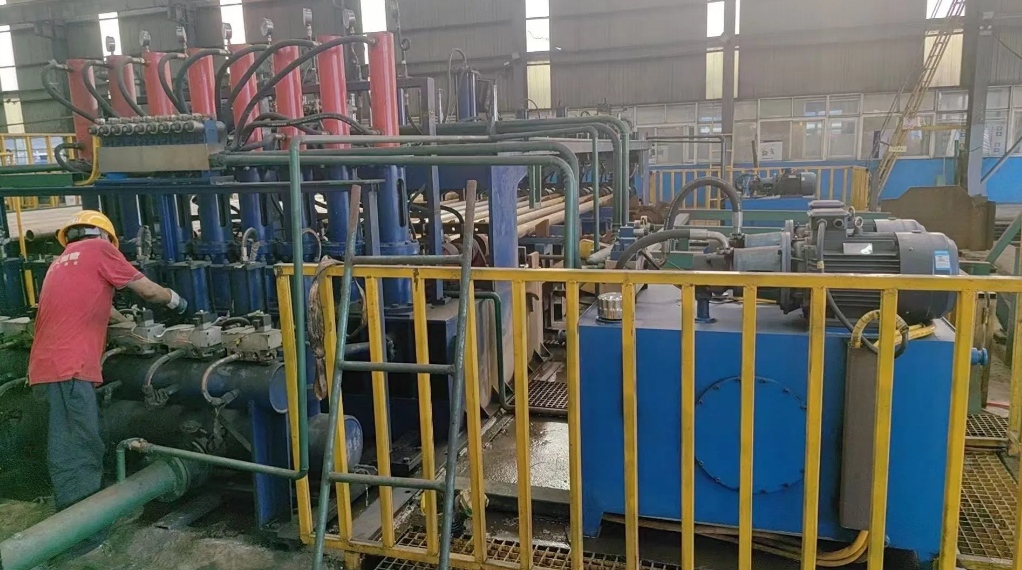
At Wuxi Marley Machinery, we pay particular attention to pressure control and sealing stability when developing hydrostatic testing systems. Once the required test pressure is reached, the system needs to maintain the specified pressure for the required holding period while continuously monitoring the test condition.
Stable pressure control reduces unnecessary operator intervention and helps maintain consistent testing conditions from one pipe to the next.
For steel pipe manufacturers, this repeatability is important because manual pressure adjustment can introduce differences between otherwise identical test cycles.
Matching Testing Capacity to Production Output
We believe the hydrostatic testing section should be designed around the required production rate rather than selected only according to maximum testing pressure.
For example, if a pipe mill produces pipes faster than one testing station can process them, the testing section becomes a bottleneck. Increasing upstream production will then simply create a larger queue before hydrostatic testing.
This is where multi-station testing can be useful.
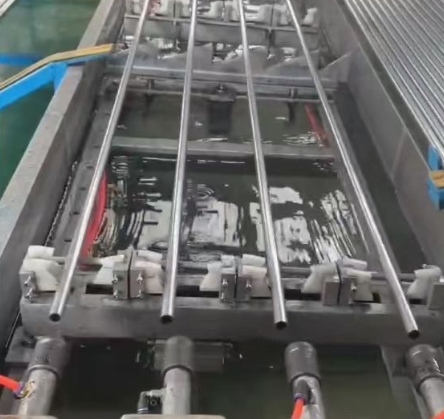
With multiple testing stations, different pipes can be at different stages of the testing cycle simultaneously. While one pipe is under pressure, another can be positioned or unloaded, depending on the machine configuration.
When we determine the testing station quantity for a project, we consider factors such as:
- Pipe diameter and length
- Required test pressure
- Pressure holding time
- Filling and draining time
- Pipe handling time
- Required production output
This production-based approach allows the pipe hydrostatic testing machine to work as part of the complete pipe manufacturing line rather than as an isolated testing unit.
Handling Different Pipe Specifications
Many steel pipe manufacturers produce several pipe sizes according to customer requirements. Changes in diameter, length, wall thickness, or pipe grade can affect the testing process.
When developing a hydrostatic testing system, we therefore consider the expected range of pipe specifications from the beginning.
Appropriate sealing arrangements, pipe handling systems, and adjustable testing parameters can reduce unnecessary setup work when changing from one pipe specification to another.
For a manufacturer producing multiple pipe sizes, shorter changeover time can improve equipment utilization and help maintain a more stable production schedule.
Automation That Supports Production
For us, automation is not simply about reducing the number of operators.
The more important objective is to remove repetitive manual operations and give operators better control over the testing process.
Our pipe hydrostatic testing machine can use PLC-based control to coordinate the testing sequence, while pressure sensors and monitoring systems provide the information required during testing.
Depending on the project requirements, test parameters and relevant testing data can also be recorded for quality control and traceability.
This allows the operator to supervise the process instead of manually controlling every individual step.
How We Evaluate Testing Efficiency
When we evaluate a hydrostatic testing system for a steel pipe manufacturer, we look at the complete cycle:
Loading → Positioning → Sealing → Filling → Pressurization → Pressure Holding → Depressurization → Unloading
Maximum test pressure is important, but it is only one part of the equipment specification.
We also consider:
- Total testing cycle time
- Pipe handling method
- Sealing stability
- Pressure control
- Number of testing stations
- Automation requirements
- Pipe specification changes
- Data recording
- Integration with upstream and downstream equipment
This approach helps us configure the equipment according to the manufacturer's actual production requirements rather than relying on a standard machine configuration.
A well-configured pipe hydrostatic testing machine reduces handling time, stabilizes the testing sequence, minimizes manual intervention, and provides the testing capacity required by the production line. For steel pipe manufacturers, these improvements help increase testing throughput without compromising pressure testing consistency.


