


 HOME
How Pipe Hydrotesters Ensure the Strength and Safety of Steel Pipes
11 November 2025
When you think about steel pipes — especially in demanding environments like oil, gas or high-pressure industrial systems — you realise you’re not just moving fluid from A to B. You’re relying on metal to perform under stress, time, and varying conditions. That’s why the humble yet powerful pipe hydrotester plays such a critical role. Let’s walk through how it ensures both strength and safety of steel pipes, in plain terms.
1. Verifying structural strength
A steel pipe might look perfect on the outside, but what matters is how it holds up under pressure. A properly-designed hydrostatic test uses a fluid (usually water) to pressurise the pipe internally and check whether it can safely withstand conditions beyond its normal operating environment. According to industry guidance, the test pressure often exceeds the pipe’s normal operating pressure.
For example, if you have a pipe rated for a certain working pressure, the hydrotester may push it to 125 % or more of that value momentarily to check for material, weld, or seam deficiencies.
This step uncovers hidden weaknesses—micro-cracks, poor welds, thinning walls—that might fail later.
2. Ensuring leak-free performance
A pipe that holds pressure isn’t doing the job if it leaks. Hydrotesters are used to detect leaks that may not be visible in normal inspection: under welds, along seams, in the body of the pipe. In a typical hydrostatic test, once water is filled and air is vented, pressure is applied and held for a period of time, while monitoring for pressure drop or fluid escape.
When a pipe passes the test without measurable pressure loss or visible leakage, it gives confidence that when the pipe is in service, it won’t surprise you with a failure.
3. Validating manufacturing and weld quality
Throughout the manufacturing of steel pipes – whether seamless, welded or other – there are numerous opportunities for imperfections: inconsistent material quality, welding defects, improper heat treatment, misalignment, etc. A hydrotester doesn’t correct those defects, but it reveals them. A blog article on steel pipe quality lists hydrostatic testing among the key methods for ensuring material and weld integrity.
In effect, the hydrotester acts as both a final check in manufacturing and an early warning system in installation.
4. Supporting regulatory and safety compliance
In many jurisdictions and for many pipe applications (especially in oil & gas, chemical, water transmission) hydrostatic testing is not optional—it’s required. As one technical document puts it: the hydrostatic test “confirms the quality of fabricated assemblies, materials … and welds to ensure the pipe can safely operate within the specified maximum operating pressure (MOP) or maximum allowable operating pressure (MAOP)”.
Using a hydrotester and accumulating test records strengthens your quality assurance, supports certifications, and aligns you with standards such as API, ASME, ASTM, etc.
5. Enhancing operational safety and long-term reliability
When a pipe is installed underground or exposed to harsh environments, the cost of failure is high: environmental impact, injury, downtime, repair cost, reputation loss. A hydrotester mitigates that risk by weeding out weak pipes before use. One industry resource notes that hydrostatic testing remains a critical non-destructive method to prevent pipeline failures.
Furthermore, by capturing data (pressure vs time, leaks, deformation) you build a traceable history. That helps with predictive maintenance, integrity management, and long-term reliability.
6. What a practical hydrotesting cycle looks like
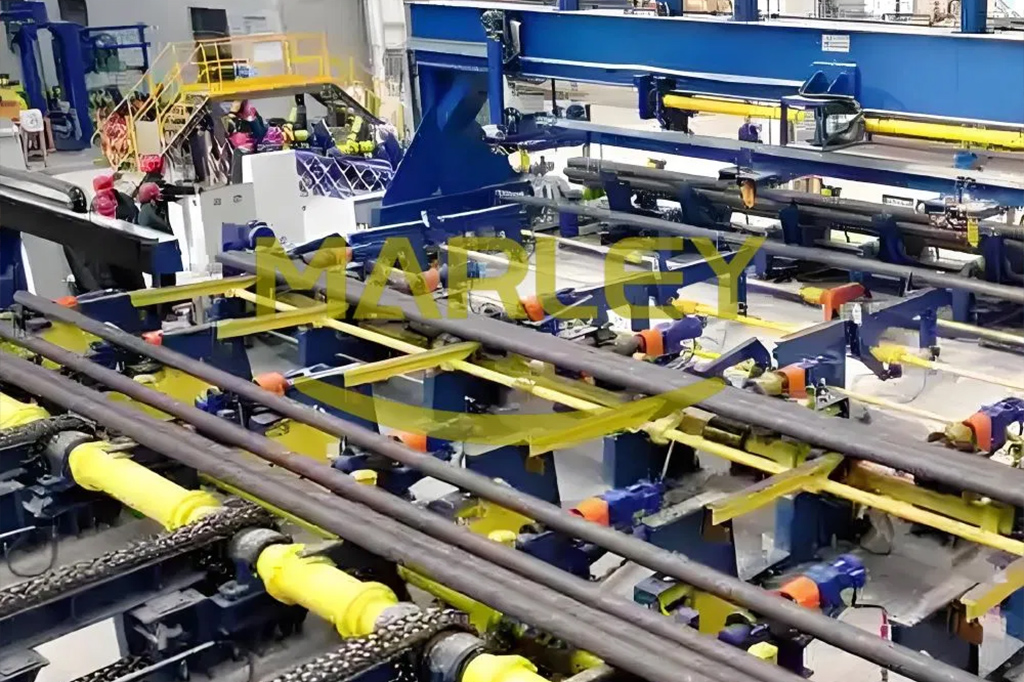
While each manufacturer or testing facility may vary, here is a simplified sequence:
-
Seal both ends of the steel pipe and fill it with water, ensuring no trapped air (air can give misleading results).
-
Gradually increase internal pressure to a predetermined level — often above the rated working pressure.
-
Hold the pressure for a specified duration while monitoring for drops or deformation.
-
Inspect for visible leaks, check welds, examine any permanent deformation.
-
Drain the fluid, document the results (pressure held, time, any drop, pass/fail).
By following a controlled cycle like this, the hydrotester ensures you’re not leaving anything to chance.
7. Why it matters for you (whether manufacturer, installer or end-user)
-
If you manufacture steel pipes: It means you can deliver product that has been proven under pressure — reducing returns, failures, warranty claims.
-
If you install or operate piping systems: It means you are inheriting a component that has been tested for strength and leak-tightness — lower risk of failure in service.
-
If you end-user critical infrastructure: You sleep better knowing the pipe you rely on has been through the worst before it ever went into service.
In short: a pipe hydrotester isn’t fancy luxury — it’s a vital gatekeeper. It’s the machine that says “this steel pipe is ready to take the pressure, handle the fluids, survive the environment.” By integrating hydrostatic testing into your pipe manufacture or pipeline installation workflow, you protect your project timeline, your safety record, and your bottom line.
So next time you see a steel pipe moving toward installation, remember there was a moment when it was filled with water, jacked up to high pressure, held for a time — and when it passed, you were that much safer.


